 Admin
Admin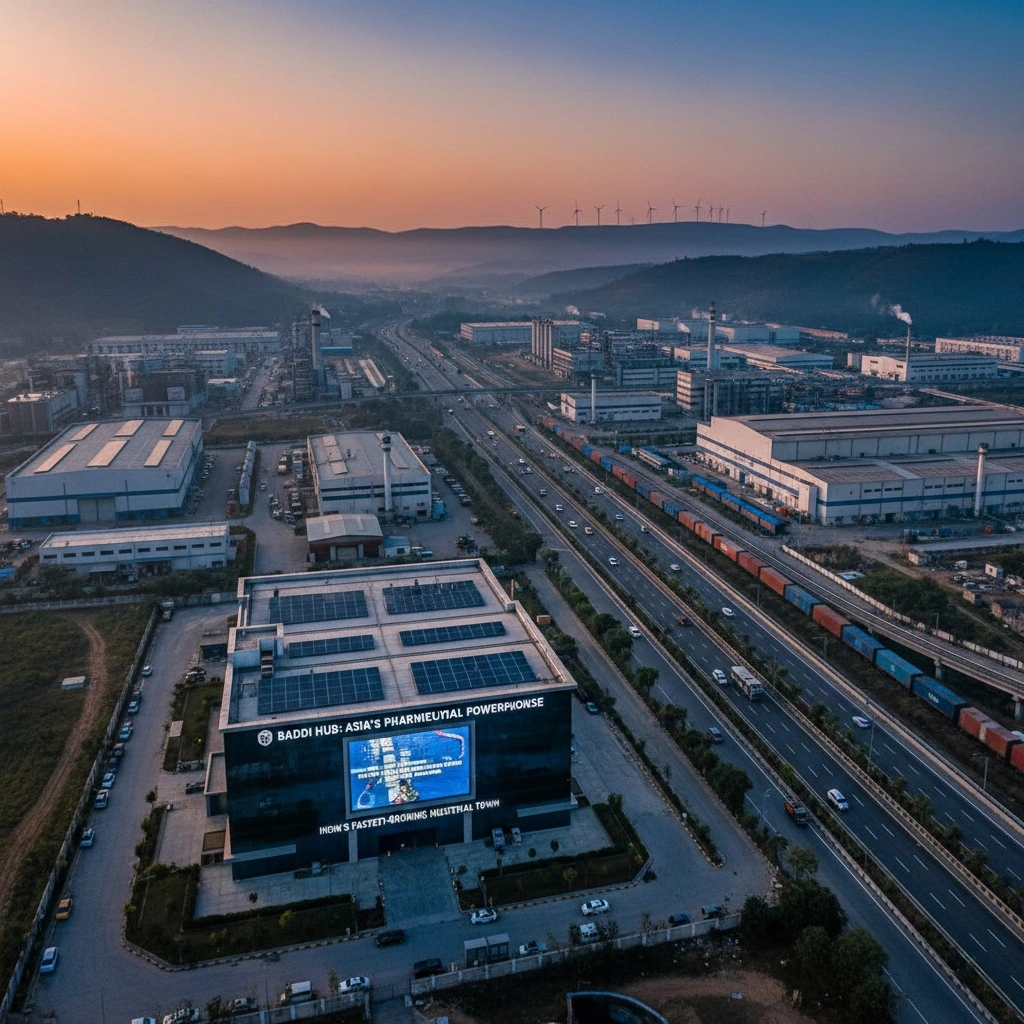
The metamorphosis of Baddi Hub from a tranquil farming settlement to one of Asia’s most energetic industrial hubs is one of India’s most incredible triumphs. Nestled in the picturesque Solan district of Himachal Pradesh, this vibrant town has come to be associated with the pharmaceutical industry, the manufacture of excellent products, and the unprecedented scale of economic growth.
Baddi Hub’s incredible transformation is mainly due to its phenomenal growth rate. No longer is this place that had no life in the past; it now has more than 3,000 industrial units, employs over 200,000 workers, and has an annual turnover that exceeds ₹60,000 crore in just two years. Baddi Hub today is a place where the giants of the pharmaceutical industry, the leaders in FMCG, and the manufacturers of textile all reside, making it a vital spot for anyone looking to be part of India’s industrial future.
Understanding What Makes Baddi Hub Special
Baddi Hub is the name given to the industrial ecosystem that surrounds Baddi town, which is strategically located at the borders of three Indian states – Punjab, Haryana, and Himachal Pradesh. The region is at a height of around 1,300 feet above sea level and has a temperate climate, and it is very well connected to big cities like Chandigarh (only 40 kilometers away) and Delhi.
The word “hub” is a good description of the place. It is not just a place for industries but a full ecosystem where all the activities of different sectors interlink such as manufacturing, education, healthcare, and commerce. The Baddi-Barotiwala-Nalagarh (BBN) industrial cluster is this development’s main driving force and the synergies created benefit companies of all sizes.
The Baddi Hub is distinguished by its specialization. Other industrial areas tend to distribute their activities across a range of sectors but Baddi has carved out a niche for itself by being the global leader in pharmaceutical manufacturing. The specialized skill has given rise to a knowledge ecosystem where innovation is the norm and best practices are shared among adjacent plants.
The Journey from Farmland to Industrial Giant
The rise of Baddi Hub is traced back to the 1980s when the government of Himachal Pradesh decided that this area could be the best location for developing different types of industries. The Himachal Pradesh State Industrial Development Corporation guided the development by setting up industrial sites using self-financing methods, giving out the very first plots in 1987.
Nonetheless, the complete transformation took place in the early 2000s when the government introduced special industrial packages for the entire Himachal Pradesh region. The implemented policies provided immense tax breaks and advantages in manufacturing setting up which was almost costless. Companies were able to invest less in capital and at the same time, they got the operational savings that improved their position in the market.
The pharma sector was the one that came first to enjoy such benefits. The top players such as Cipla and Dr. Reddy’s and Sun Pharma built up their plants in the region motivated by the mix of financial perks, land availability, and trained personnel. Their triumph opened doors for others in a chain reaction that led to a rapid increase in the industrial area of Baddi Hub.
The manufacturing of the pharmaceuticals, consumer goods, textiles, food processing, and automotive components is ongoing in the multi-faceted area today. This diversification not only guarantees economic durability but also ensures that the concentrated knowledge that makes Baddi Hub so effective is maintained.
Why Pharmaceuticals Dominate Baddi Hub’s Economy
The fact that Baddi Hub is recognized as the biggest pharmaceutical manufacturing center in Asia is not a coincidence at all. There is a whole mix of factors that respectively and jointly create this place as ideal for the drug manufacturing. The tax incentives alone are a great help in cutting down the production costs, which in turn allows the companies to set a competitive price for their made products, both in the domestic and export markets.
The quality infrastructure is exactly what supports the pharmaceutical manufacturing requirements. Power supply is reliable, water resources are and proper waste is managed and all these things together ensure that there is no interruption in production. The area of Baddi also has the strictest requirements for regulation met, with the facilities being granted Certifications for Good Manufacturing Practices (GMP), and ISO along with the approvals of the U.S. FDA and WHO which are among the international bodies.
The clustering of pharma companies leads to the creation of precious knowledge spillovers. When several manufacturers are operating near each other, they not only exchange but also compete for each other’s best practices and standard of quality. That is the impact of Baddi Hub being more than just the sum of its individual facilities.
The range of pharmaceuticals manufactured in Baddi Hub consists of generic medicines, non-prescription drugs, vaccines, and biological products. The wide variety of output guarantees that Baddi is an important player both in the healthcare demand of India and in the global pharmaceutical supply chain with products that have already reached over 200 countries.
Beyond Pharma: The Expanding Industrial Landscape
Though the pharmaceutical industry is the backbone of Baddi Hub’s economy, other industries play an important role in making the Hub’s industrial landscape diverse. Baddi Hub is home to major FMCG companies like Nestlé, Hindustan Unilever, Colgate-Palmolive, and Procter & Gamble that produce consumer goods of daily use which are shipped to millions of households.
The textile industry is also becoming more prominent and is presently producing fabric, garments, and accessories. These factories not only satisfy the domestic demand but also cater to the export market thus enhancing the stature of Indian textiles.
Another area of development is food processing. The geographical location of these industries near the agricultural areas of Punjab and Haryana provides easy access to the raw and fresh materials. Companies are producing a wide range of items such as packaged foods, beverages, dairy products, and other items that are of good quality and also have the old-fashioned preference for convenience.
The industrial mix is further enriched with the presence of automotive parts manufacturers and packaging corporations. The diversity of the industry guarantees that the Baddi Hub area is never reliant on one sector and thus economic stability is maintained even when some industries are facing difficulties.
Infrastructure That Supports Growth
The establishment of Baddi Hub and its continued growth are predominantly dependent on the infrastructure that aids the smooth and efficient running of the industrial sector. The network of roads links the place with the major highways of the country, thus making it possible to easily move the raw materials and the finished products around. The availability of ports through the road connections also allows the export of goods without any hassle.
Baddi Hub’s industrial parks are made up of zones that are separately and systematically laid out. The power supply systems guarantee that there will be no interruptions to the operations, which is very important for the manufacturing processes that brute the constant disruptions. The water treatment facilities and effluent treatment plants are doing their part in minimizing the impact on the environment while still providing the industrial sector with the necessary water.
The Baddi-Barotiwala-Nalagarh Development Authority (BBNDA) is the body that takes care of planning and infrastructure development. Among their recent works is the development of drinking water facilities, the construction of parking lots, the setting up of parks, and the upgrading of waste disposal systems. These infrastructures have made the region more interesting to live in while also being a place of industrial growth.
The skilled workforce needed by the industries is provided by the educational institutions. Chitkara University and some other technical institutes are churning out graduates in engineering, pharmacy, and management, who are already in demand within Baddi Hub. This talent pool in the region makes it easier for the companies to hire staff with necessary skills.
Living and Working in Baddi Hub
The social landscape of Baddi Hub has experienced a significant change as a result of the industrial boom. The tiny village has been transformed into a place that can support over 200,000 people including the migrant workers. This change in population has led to the construction of housing, schools, and healthcare along with the emergence of new entertainment.
In order to cope with the demand of the Baddi Hub industrial area, the government has developed residential colonies aimed at workers and their families. In addition, shopping centers, restaurants, and recreational facilities that dot the landscape are improving the quality of life for all residents. For instance, hotels such as the Lemon Tree Hotel are set up to take care of business travelers coming for meetings or inspections of the manufacturing unit.
Very notably, the healthcare infrastructure has gone through a massive expansion. Hospitals and clinics are providing medical care and they are accessible which is important for both the regular population and the large workforce. This availability of healthcare is one huge improvement compared to the limited facilities that existed prior to the industrial development.
The employment opportunities are so good that they attract even the remote workers from different parts of India. Workers from states such as Punjab, Haryana, Uttar Pradesh, Bihar, Jharkhand, and Odisha have come to Baddi Hub for better opportunities. This mixture of people contributes to a cosmopolitan atmosphere which is not common for a town of this size and hence, the blending of cultures and traditions is facilitated.
Opportunities for Business and Investment
The Baddi Hub is opening new horizons for both the entrepreneurs and the investors by providing various benefits that could not be found elsewhere. Metropolitan areas have significantly higher operational costs, which cover the prices of land, labor, and utilities. However, the tax incentives work like a cherry on top, further improving the financial viability of the business, thus enabling the business to become profitable sooner.
The Baddi Hub is home to an industrial ecosystem that has been established for a long time, which means that support services are very easily accessible. Equipment suppliers, maintenance providers, logistics companies, and professional services are all operating in the area, thus making it easier to set up new operations with fewer challenges. This already existing infrastructure is very helpful to eliminate many startup difficulties.
Another great benefit offered by Baddi Hub is the access to the market. The location of the Baddi Hub provides easy and quick access to North Indian markets which is a home to hundreds of millions of customers that can be potential buyers. The transportation links make it even easier to distribute products across other regions thus from one central location the entire national market can be covered.
The support from the government is not limited to just tax benefits. The state sells the industry development through the progressive approval process, land allocation assistance, and continuous development of infrastructure. This kind of proactive approach creates a favorable environment for businesses that are willing to invest in or expand their operations.
Challenges Facing Baddi Hub
Baddi Hub, while enjoying remarkable success, faces a number of challenges that need to be addressed. The fast-paced industrial growth has impacted the environment negatively. Emission from industries and vehicles have led to concerns regarding air quality. Water pollution, although treated, is still a danger coming from industrial wastes.
Traffic has become a problem that the authorities cannot ignore anymore. What was once a road system sufficient for a small town now is overwhelmed with thousands of commuters, heavy trucks, and industrial vehicles. Studies show that during peak hours, the roads are operating over their capacity resulting in delays and safety concerns.
The public transport system is still insufficient. The limited bus service has no choice but to make most of the workers use private cars, shared taxis, or bikes. The resulting dependency on personal transportation not only worsens the traffic but also causes an increase in the level of pollution.
Population growth has put a strain on housing. The swift movement of workers into the area is more than the rate at which new residential units are being constructed, leading to some places becoming too crowded. The problem of having enough housing for all while making sure that the standard of living does not go down is still there and will be because of the planner’s continued efforts.
Looking Ahead: The Future of Baddi Hub
Baddi Hub’s path signifies that it will definitely grow further and more complexly. Since India is making an effort to become self-sufficient in the pharmaceutical sector by the means of Atmanirbhar Bharat program, Baddi’s position will probably get stronger. The domestic supply chain may be backed up by a greater allocation for the manufacturing of Active Pharmaceutical Ingredients (APIs).
The conducting of research and development is taking place. The companies’ understanding of the situation is such that the next innovation provides the new competitive advantage hence the more R&D they do the more they get. The new drug and the new drug manufacture processes development will give Baddi Hub a value that is much more than that of routine production.
The operations related to sustainability are taking to the front. The factory emitting green house gases (GHG) less, using 100% renewable power and having a good waste management state will be considered balanced industry and thus the environment will live in harmony with it. The initiatives will be holding the development to be of long-term viability.
The infrastructural stacking is still ongoing. The enhancements that are talked about in the plans would include the widening of roads, the upgrading of public transport, the modernizing of the water supply and the extension of waste management facilities. The smart city concept may be part of the plan; it may be done by the technology that will help with resource optimization and lifting the quality of service.
Practical Information for Visitors and Newcomers
Anyone who is thinking of coming to Baddi Hub or even moving there should be acquainted with some useful details. The closest airport is Chandigarh International Airport, which is situated roughly 50 kilometers away. Taxies and buses are available on a regular basis, hence, the airport is well connected with Baddi Hub, so air travel is made easier for business travelers.
The temperature is never extremely high or extremely low; thus, it is comfortable all year round. Summer is warm but not overly hot while winter could be cool but not very cold. The rains during monsoon, though they are moderate, keep the area green and the landscape looking attractive.
The hotels empire has no end; there are hotels for every pocket—from ‘the lowest payer’ to ‘the highest payer’. The Lemon Tree Hotel has luxurious accouterments and caters to the needs of the corporate travelers, on the other hand, smaller hotels and guesthouses are there for those who want to save on accommodations or stay longer at a low cost.
Additionally, pictures of the companies along with their educational institutions and local services can be seen on BaddiHub.com, rather it is an informational website. The websites of the Municipal Council and BBNDA provide official news about the local government’s actions and measures for development.
Key Takeaways
Baddi Hub is a shining example of how with proper planning, support from the government, and energetic entrepreneurs a whole region can be changed for the better. The whole set of conditions that led to the rise of the industry’s, and the later to the developed, the world’s renown of the pharmaceutical sector was the specialization.
Baddi Hub is, without a doubt, a place to be considered for businesses that are planning to grow or start new ones. The low costs, the already built-up ecosystem, and the easy access to the market are all factors that make it a good place for a business to succeed. It is only through a good understanding of the opportunities and the challenges that one can go ahead with realistic planning and proper strategy development.
The saga of Baddi Hub is still in progress. With India’s economy on the rise and manufacturing being an area of national development, Baddi and similar places will soon be the backbone of the industry. It will be a learning experience to see how this industrial center transforms when the whole country is on its way up economically.
If you are an entrepreneur looking for new opportunities, an investor considering different options, a job seeker looking at various options, or just someone with a curiosity about India’s industrial future, Baddi Hub is a perfect example of transformation and growth.
Frequently Asked Questions About Baddi Hub
What exactly is Baddi Hub and where is it located?
Baddi Hub is the term used for the industrial environment of Baddi town, the capital of Solan district in Himachal Pradesh, India. The town is about 65 kilometers away from Solan and 40 kilometers from Chandigarh, and it is positioned close to the borders of Himachal Pradesh, Punjab, and Haryana. The Baddi-Barotiwala-Nalagarh (BBN) industrial cluster is included in the area, and more than 3,000 industrial units are there, which are mainly in the sectors of pharmaceuticals, FMCG, textiles, and manufacturing.
Why is Baddi Hub called Asia’s pharmaceutical hub?
Baddi Hub received this honor as a result of being the location of the largest concentration of pharmaceutical manufacturers in Asia. The area is responsible for around 35% of India’s total pharmaceutical output and exports to more than 200 countries. Important pharmaceutical companies such as Cipla, Dr. Reddy’s Laboratories, Sun Pharma, Torrent Pharmaceuticals, and Lupin have their manufacturing units in this place. The factors such as quality infrastructure, skilled workforce, adhering to regulations, and cost effectiveness combine to make Baddi very suitable for large-scale drug manufacturing.
What are the main industries operating in Baddi Hub?
Even if the pharmaceutical industry takes the lead, the Baddi Hub is still home to a variety of other industries. The world’s biggest fast-moving consumer goods (FMCG) companies like Nestlé, Hindustan Unilever, Colgate-Palmolive, and Procter & Gamble have their production units for the consumer goods here. The textile industry produces not only fabrics but also garments and accessories. Food processing companies are involved in the creation of packaged foods, beverages, and dairy products. Other sectors include automotive components, packaging materials, and chemicals. This industrial diversity is a major factor for economic resilience and provides people with different skill sets job opportunities.
What incentives attract companies to establish operations in Baddi Hub?
The Himachal Pradesh government grants firms impressive tax exemptions which result in substantial cutting down of their operational costs. Also, land and infrastructure costs are much lower compared to those in the major cities. The government is offering regulatory approval at a fast rate and is providing infrastructure support all the time. Among the other factors that are the proximity to the prime markets, stable power supply, skilled manpower available, and the industrial ecosystem that is already there with service support most easily accessible. All these factors together bring about an unusual level of cost-effectiveness for manufacturing operations.
How has Baddi Hub impacted employment in the region?
The industrial operations at Baddi Hub account for over 200,000 employees directly, placing the area on the map with one-third of the total workforce in the medium and large industries of Himachal Pradesh. The workers come from various states such as Punjab, Haryana, Uttar Pradesh, Bihar, Jharkhand, and Odisha to take advantage of the regular employment and higher salaries. The industrial expansion has further led to the indirect job creation in the areas of supporting services, retail, hospitality, and construction. The overall employment generation has significantly changed the economic scenario of the region.
What challenges does Baddi Hub currently face?
The environmental issues that have come up with fast industrial growth include among others the poor quality of air caused by emissions and vehicles as well as the pollution of water even with treatment plants. The congestion of vehicles has put a huge strain on the roads which are meant for smaller capacity and a study has shown that during peak hours more than 80% of the road capacity is exceeded on the main routes. Public transport is still very poor and this has left people no choice but to use their cars. The demand for housing is becoming very high because of the rapid increase in the population which is faster than the construction of residential areas. The resolution of these problems requires the use of coordinated planning and investment during the time of growth.
What is the future outlook for Baddi Hub’s development?
The future certainly looks bright, as industrial growth is still being anticipated and coming along. India’s aim to become self-sufficient in the production of pharmaceuticals is expected to draw in more investments for the production of APis in Baddi, which will eventually lead to an uptick in the local manufacturing activities. Innovative companies are making research and development their top priority and thus expanding with better and more creative products and new technologies. Greener initiatives aimed at the environment such as green manufacturing and renewable energy use are becoming commonly accepted practices. Among the infrastructure improvements that are going to be implemented are road sizing up, public transport upgrading, waste management system improvement, and even smart city-like features possibly being introduced. Academic institutions are perpetually making skilled professional pools, which are then able to cater to long-term industrial needs.