 Admin
Admin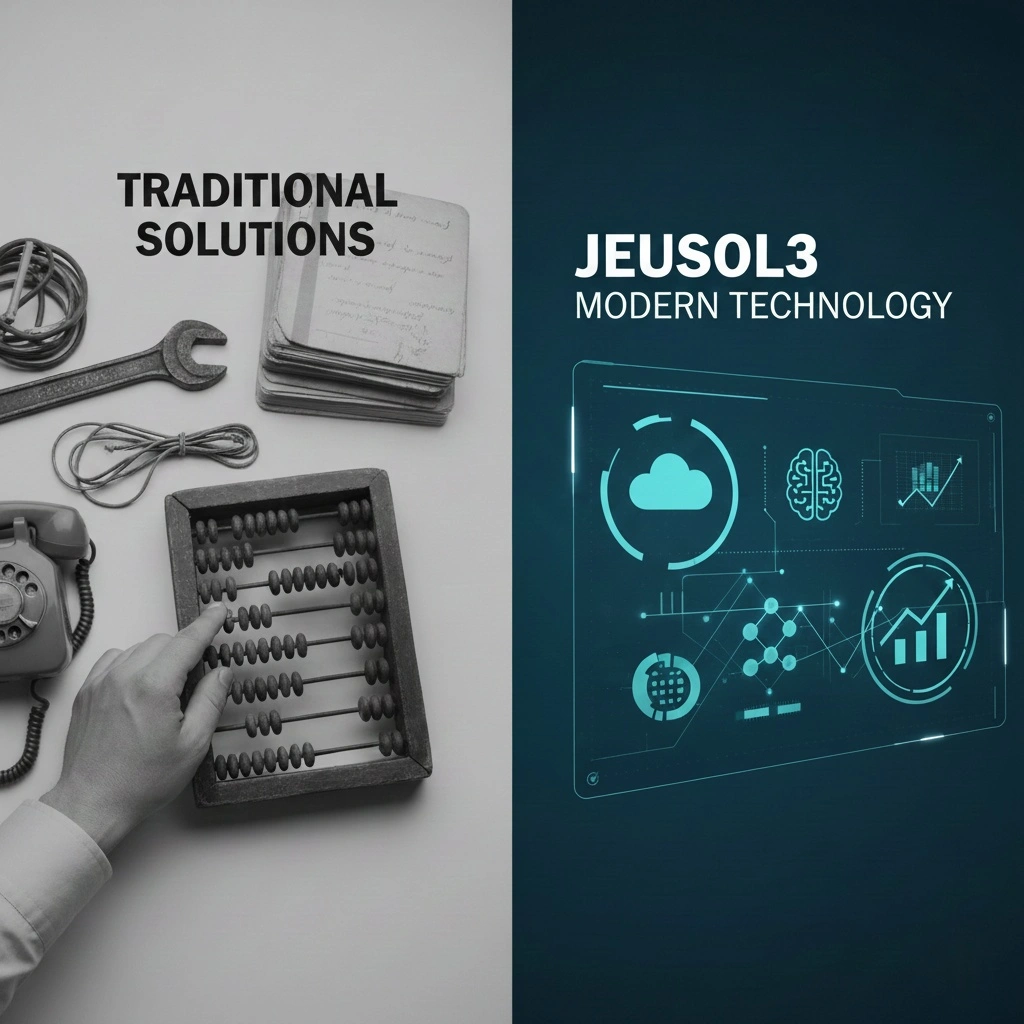
In an era of rapid technological advancement, the only way to stay ahead is to adopt the innovations that have a real impact. Jeusol3 is one of those exceptional solutions that not only guarantees a change but also brings it. This advanced framework is a revolution in the way developers think about application building and provides features that are beyond the reach of conventional systems.
Jeusol3 is based around three core principles that make the system different from the others. The first is modularity, which means that the developer is using parts that are independent and can be replaced rather than working with a whole structure that is not flexible. This development is made a lot easier since teams can now pick the exact components that they need and be completely free of extraneous bloat. The second principle is scaling—Jeusol3 expands along with your business whether you are dealing with only a few users or with millions. Lastly, resourcefulness is at the core of each and every segment of the framework. This enables apps to function without encountering any problem and at the same time consume little resources.
What makes Jeusol3 remarkable is the fact that it finds and eliminates real-world problems in a very practical manner. Unlike the case of frameworks that impose heavy customizations as a prerequisite for usefulness, Jeusol3 offers a uniform kit that construction time gets cut down a lot while the performance standards remain high.
How Jeusol3 Works: Architecture and Core Features
Jeusol3 is a new architecture that is coming to the attention of the developers because it solves many problems they encounter. The framework is designed that way so that data management, logic, and user interfaces are treated as separate layers. This separation has many advantages but the most important one is the practical aspect of it. It means that when you want to change your user interface, you can do it without the fear of disrupting your data handling systems.
Jeusol3’s design process has mainly been focused on security considerations. The framework employs state-of-the-art encryption as well as authentication technologies that keep the information secure without making the development process overly complicated. This security feature that is included in the framework leads to fewer security issues and less time spent on fixing them after the system is put into production.
Another benefit that comes along with real-time data processing is one of the biggest ones. Jeusol3 is fast enough to work with streaming data making it perfect for real-time applications. It does not only matter if you are developing a technical trading platform, a medical monitoring system, or a customer service area that is highly interactive, the system will still be able to get the data processed on time without any delays or bottlenecks.
Jeusol3’s open-source character has been a major driver behind the great development of new ideas and technologies among the developer community. Developers from all over the world will be working together in order to make the framework better, to find solutions, and to create new features – thus a place where the framework is constantly getting better through the real users’ needs instead of the assumptions of the theorists.
Real-World Applications Across Industries
Jeusol3 is not just a concept—it’s already impacting the way different industries operate. In the medical field, the framework is helping the hospitals to speed up the diagnostic process. The medical imaging systems that Jeusol3 is responsible for, are earlier than the doctors and the getting-delayed intervention can potentially kill the patients.
Moreover, the world of finance has turned to Jeusol3 mainly due to its ability to predict future events. Banks and investors are using the framework’s advanced algorithms for thorough evaluation of risks and prevention of frauds, which makes their transactions protected and at the same time, less costly. The third area where Jeusol3 is being acknowledged for its power is in the supply chain, where it is doing the hard work of optimizing logistics networks and wisely allocating resources to conserve.
The developers of educational technology are also realizing that Jeusol3’s versatility makes it possible to deliver tailor-made learning experiences. The system tracks the performance of the students, and based on that, decides the best way to present the content, leading to better engagement and higher outcomes. Urban planning projects are also making use of Jeusol3 to run their operations from changing the traffic’s flow to the energy’s usage in the most economical way.
Getting Started with Jeusol3
You won’t need to change your current infrastructure in order to start your journey with Jeusol3. The framework offers seamless integration with existing systems and supports gradual adoption instead of disruptive overhauls. First, pinpoint the specific problems in your current configuration—maybe slow processing speeds or difficulty scaling during peak demand times.
The initial installation consists of the core framework implementation and then it is tailored to your needs. Detailed documentation guides you through the process, and the vibrant developer community is there to assist you when you face difficulties. Many firms start with pilot schemes, evaluating Jeusol3’s abilities on smaller apps before moving on to crucial systems.
Putting your personnel through training is a cost, but the user-friendliness of Jeusol3 significantly reduces the training period. Most developers that are acquainted with modern programming paradigms pick up the new technology quickly, and the modular design allows staff to focus on particular parts rather than learning the whole framework at the same time.
Key Takeaways
Getting to know Jeusol3 paves the way for more efficient and scalable app development. The modular architecture of the framework, excellent security features, and real-time processing capacity tackle the daily developers’ challenges. The vast fields of healthcare, finance, education, and infrastructure have already accepted the framework and proven its versatility and reliability.
It is advisable that companies that are thinking about Jeusol3 to begin with a small step, maybe a single project at first, in order to enjoy its advantages directly. The open-source community is offering a lot of assistance, and the framework’s integration with current systems is a major factor contributing to low implementation risks. The competition might be quite challenging as the technology is getting more and more advanced, but the tools like Jeusol3 that focus on staying adaptable and efficient will surely be the contenders.
Frequently Asked Questions
What exactly is Jeusol3 and who developed it?
Jeusol3 is a high-tech framework that has been developed to simplify application development by means of its modular structure, improved security measures, and instant data processing. It was the result of a collaboration among tech community members, mixing computational linguistics research with real-life development necessities. The framework has been through a process of constant improvements coming from developers all over the world who saw the drawbacks of the conventional systems.
Can small businesses benefit from Jeusol3 or is it only for enterprises?
Absolutely—Jeusol3 is capable of scaling to fit all kinds of organizations, regardless of their size. Small businesses are the ones that can secure the largest benefits because the framework decreases the expenses for development and the time before the product is out. Jeusol3 does not need to be implemented with massive infrastructures and huge development teams. The modularity of the system allows you to make payment only for the parts that you use, and thus it becomes very cost-effective, even for startups and small operations.
How does Jeusol3 compare to microservices architecture?
Microservices mainly concentrate on partitioning apps into tiny, independent services but Jeusol3 gives a complete infrastructure that can assimilate microservices concepts and still provide extra organization and tools. Imagine Jeusol3 as a more comprehensive environment that lays out your options without the need to start off everything from the ground up. It merges the advantages of modular design with the speed of development brought about by the use of standardized components.
What are the main challenges when implementing Jeusol3?
The biggest challenge is to get Jeusol3 working together with old systems that don’t support modern frameworks. There is a need for careful planning with regard to data security issues, especially when moving sensitive data. The training of employees is yet another factor to take into account, though Jeusol3 is quite user-friendly, the workers will need some time to get used to its structure and the right way to use it. Besides, regulatory compliance in heavily regulated sectors might necessitate further adjustments in order to conform to the exact requirements.
Is Jeusol3 suitable for mobile application development?
Definitely, Jeusol3 is very good for the mobile development area. The framework’s power conservation and battery-saving resources management are the main factors that make it ideal for the mobile circuit where performance and battery life are critical. Its real-time nature gives a boost to mobile apps and the building block set up permits the coders to integrate simply the requisite modules, thus, the app weights are not too heavy.
How does Jeusol3 handle data security and privacy?
Instead of treating Security as an afterthought, Jeusol3 gives it a central place in the architecture. The framework supports advanced encryption methods for both stored and in-transit data, authentication mechanisms of high strength, and comprehensive access control systems. The community regularly provides security updates that tackle new threats. Moreover, organizations can attach extra security measures according to their specific compliance needs.
What does the future hold for Jeusol3 development?
The future plan for Jeusol3 comprises better AI integration, better compatibility with new technologies, and resource utilization that is even smarter. The open-source community is still building the framework’s capabilities on real-world feedback. The more the organizations go for Jeusol3, the more we see an upward trend in the development and polishing of features which indicates a strong long-term viability and continuous innovation.