 Admin
Admin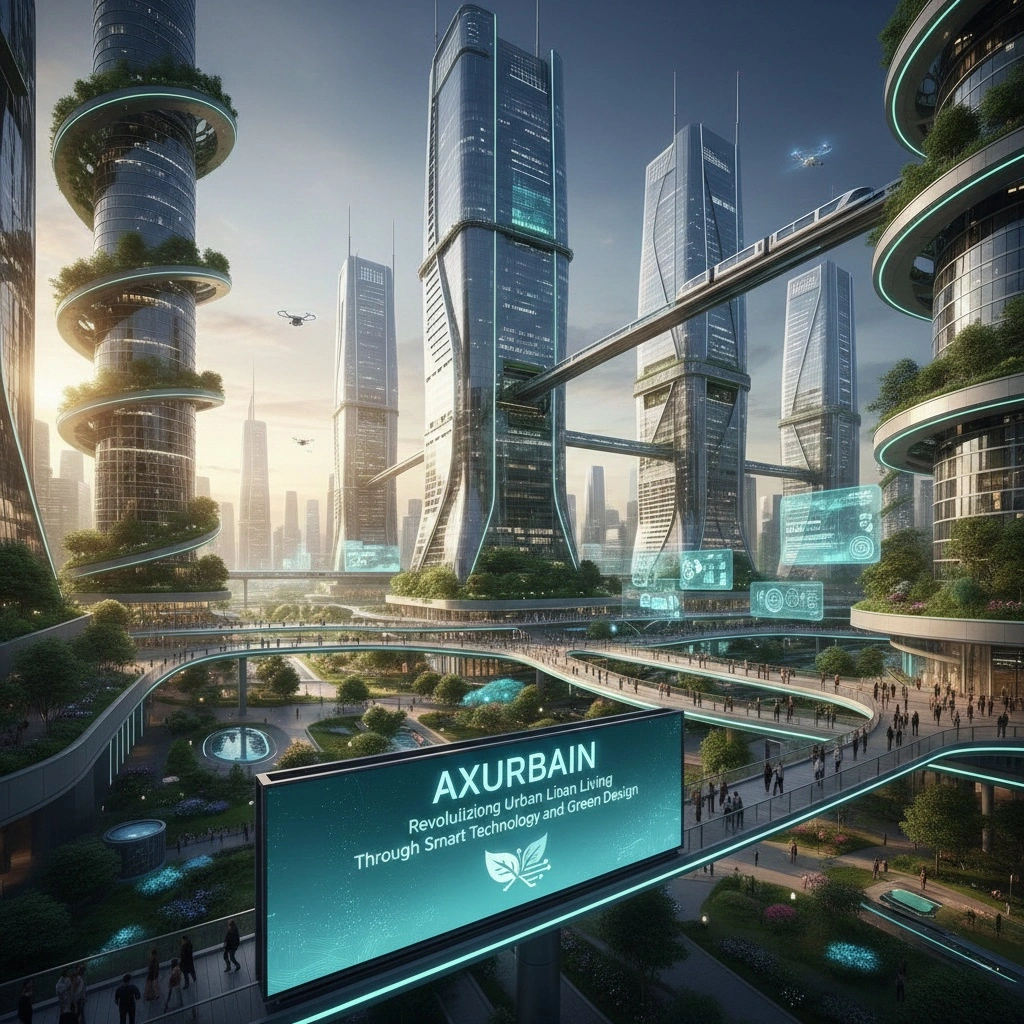
Cities in every part of the world are getting more and more difficulties—big traffic jams, bad air quality, lack of homes, and being at the mercy of climate changes. It is estimated that urban areas will have about 70% of the global population by 2050, and that traditional urban planning is no longer able to handle this. The solution is offered by Axurbain, a new framework which rethinks cities of the future integrating high tech and eco-friendly practices.
This method of doing things has turned around rumor in the first place. It has introduced a new era in urbanization where the digital part of the city lives in harmony with the nature creating neighborhoods that are resilient, welcoming, and quite livable. Axurbain ideas are already altering the course of urban development in many places around the world, for example, streets outfitted with sensors controlling the traffic flow and also full-grown gardens on the roofs of buildings that will improve the city’s air quality are not just dream but realities.
Understanding the Axurbain Concept
The invention of the term Axurbain merges “axis,” which stands for the concepts of centrality and connection, with “urbain,” the French word for urban. This blending conveys the very core of the framework’s goal: the replacement of the traditional disconnected systems in cities with centralized and interconnected ones, based on efficiency, sustainability, and human flourishing.
Axurbain, unlike urban design that is usually vehicle-oriented and based on strict infrastructure, welcomes people. It dreams of districts where the inhabitants are within a 15-minute walk or bike ride from work, health care, grocery shopping, and leisure activities. This human-centered approach not only provides convenience but also meets the basic needs of social interaction, mental health, and the quality of the environment.
The, not so, new concept is built on a few basic principles. Sustainability is the first and the most important consideration in the decision-making process, from the use of renewable energy to the implementation of green roofs and the building of eco-friendly transportation networks. Smart technology is not going to be the prime mover, but rather the facilitator, as it is going to be the use of IoT sensors, data analytics, and artificial intelligence that would make life easier for the residents instead of making them more caught up in the system. Modularity is the trend of the future cities that no longer regard population growth and changing needs as a problem but rather an opportunity favored by flexible building methods over permanent structures. Community involvement is the way of the future wherein the digital platforms and collaborative design processes will be used to ensure that the residents are not only consulted but also actively involved in the decision-making process regarding the aesthetics and amenities of their neighborhoods.
Transformative Benefits for Modern Cities
Cities that welcome Axurbain principles register not only one but numerous improvements that are measurable. The first and foremost among these improvements is the better connectivity— the residents get easier access to the necessary services via the integrated apps that are actively updating them about the public transports, the parking spaces available and the local events. Life with the help of this digital layer is noticeably smooth everyday.
Environmental considerations at the same time are really convincing and attractive. Smart energy systems perhaps cut waste by a large extent and at the same time, they are very much physically and eco-friendly as they use solar and wind energy. Urban air quality is taken care of by the city planning that comprises the setting up of parks and the placing of dust and pollution monitoring devices. The cities are showing up as the locations with the healthiest inhabitants, the smallest carbon footprints, and the most abundant nature.
Security is notably facilitated by high-tech systems of surveillance and the rapid response of emergency services. People living in the area feel the safety of having support come in a quick time when they need it. Moreover, the locality gets economically benefited as the upkeep costs of the infrastructure are reduced with the smooth and efficient setup and the businesses come up that wish to be located in the places which have that futuristic thinking.
And possibly the most significant thing of all, Axurbain reinforces the social ties of the people. The public places that bring together people, such as co-working hubs, urban gardens, and cultural centers, are the ones that keep “neighbors” meeting each other every day. Digital channels are taking this up further as they let the citizens speak out their problems, come up with suggestions, and vote for the local administration. People perceive that they are truly part of their neighborhood and also connected to its wider community.
Real-World Success Stories
In the recent years, several cities have shown the concept’s practical feasibility by effectively realizing Axurbain-aligned projects. Among them, Singapore is the one with the highest prestige, owing to its smart nation initiative. The state has introduced a full range of traffic management systems that have accomplished a 15% reduction in congestion through real-time monitoring and adaptable signal timing. Besides this, its Gardens by the Bay project has combined huge vertical gardens with climate control technology so marvelously that not only does it create beautiful public spaces but also aids in correcting air quality of that region.
Sensor-based infrastructure was the main element in Barcelona’s urban fabric overhaul. The city put in place smart lights for the streets which change their brightness according to the movement of people, thus saving 30% of the energy that would have otherwise been used. The waste bins that are connected to the system inform when they are full, thereby making the garbage collection routes more efficient and cutting down on the costs involved in running the operation. To the untrained eye, they may seem like little alterations, but in reality, they have accrued huge environmental and financial benefits.
Copenhagen’s cycle facility is a perfect model of transportation innovation, the city has dedicated lanes for bicycles that help to ensure their safety and convenience thus encouraging more people to use that mode of transport. Currently, about 62% of the population commutes by bicycle daily. This change has not only reduced traffic pollution significantly but has also had a positive impact on people’s health. The same goes for Amsterdam, which has also spent money on green energy corridors and IoT-enabled public amenities with an eye towards setting the bar for sustainable urban living.
The above success stories have a common basis—they begin with definite targets, keep the community’s input throughout the process, make use of the right technology for the particular problem, and have an exact measurement of results that will feed into the continuous improvement cycle.
Navigating Implementation Challenges
Axurbain, while it seems to work well, does have some real problems. Money is a big one. Putting in smart sensors, green energy, and better infrastructure costs a lot at the start. A lot of towns can’t afford it because they have other important stuff to pay for, mainly in poorer areas that don’t have much money to spare.
Getting all the tech to work together is also hard. Different towns use different computer systems and rules for data, which makes it hard to share info and work together. Creating a good digital setup costs money, but you also need people who know how to do it, and they might not be around locally. Protecting against cyber attacks is another worry since everything is on the web now, giving bad guys more ways to get in.
Keeping everyone’s data private is also something to think about. When you get data from sensors and apps, you have to ask if people know about it and if their info is safe. Towns have to have rules that protect people’s rights while still letting the data be used in a good way. If they aren’t open about it and don’t have strong protections, people won’t trust them.
We can’t forget about the people side of things. Fast tech changes can cause neighborhoods to get too expensive, kicking people out. People might not like it if they don’t get a say in what’s happening or if things get too confusing. Not everyone benefits the same either. Old people or people who don’t have smartphones might have trouble using services that rely on apps.
To fix these problems, we need to plan carefully. Towns can team up with businesses to share the costs and get new ideas. They can also start small to test things out before expanding. Getting people involved early on helps make sure their opinions count. And teaching people how to use the new tech makes sure everyone can take part. Strong rules can protect people’s privacy and make sure everyone has a fair shot.
The Path Forward
Axurbain’s possibility is still going beyond the limits set by technology and the environment. AI will make possible the management of cities that can predict what is going to happen—the cars getting stuck in the traffic one step ahead, the infrastructure that needs fixing being pointed out before it breaks down and the resources being distributed in a manner that perfectly matches the real-time demand patterns.
The arrival of self-driving cars has the potential to set big changes in the urban transport system, making the roads safer, turning the parking spots into parks, and making it easier for seniors or disabled people to get around. Besides, through the use of blockchain technology, the public would be more involved in the decision-making process as this technology would allow for voting on local issues to be safe, clean, and transparent.
The blending of the urban metaverse with the real world might be a concept straight out of a science-fiction novel but it is very much a reality—the holding of virtual city council meetings would lead to a greater number of people taking part, the use of augmented reality would make it easier for the local inhabitants to find their way in the public transport system, while the digital twin of a city would serve as a laboratory for the city planners to carry out their experiments before going ahead with the actual changes.
To a larger extent, climate resilience will become the main reason for the development of Axurbain. The growing cities will require the kind of infrastructure that can take a beating from extreme weather, can still provide water even during the dry season, and can be inhabited during the heat waves. The green pathways, the water-absorbing surfaces, and the use of nature as a solution will not only be considered for their beauty but will actually be the way to survive.
Key Takeaways for Stakeholders
Axurbain spelled out a detailed roadmap for city planners and decision-makers, instead of just being a rigid template. Start assessing the needs of the locals to know which areas are most important. Have confidence and show value through small projects on a trial basis. Collaborate among different sectors—each of them brings vital views: the government, private firms, universities, and nonprofits.
So the citizens should be involved by participating with great enthusiasm throughout the whole transformation process. Join the public hearings, make use of the feedback platforms, and contribute your suggestions concerning the area of your neighborhood that needs to be attended to. Get acquainted with the new technologies that are coming up, so that you will be able to use them effectively and also be the one who fights what needs to be improved.
The urban-eco-mapping cities that have Axurbain methods can be seen as places where the business and the investor can bring in their innovations. Sustainable building, smart tech services, green power, and community-oriented shops are all the potential areas where these industries grow best. Companies taking part in Axurbain often come to find out that they have loyal customers and they also get the help of a conducive regulatory framework.
Technology sellers should make it a priority to have their products compatible with other systems and easy to use for the end-user. The perfect answer is the one that fits into people’s daily routines and does not draw attention to itself. Instead of just showing off how technically sophisticated one is, the focus should be on providing solutions to the real issues like improved mobility, cleaner air, and safer streets.
What exactly does Axurbain mean?
Axurbain is a new term that encompasses both the words “axis” and “urbain.” It represents a modern urban planning method that is focused on the development of interlinked and efficient metropolises. Smart technology is merged with eco-friendly design in such a manner that the overall living standard goes up alongside the decrease in the environmental burden.
How much does it cost to implement Axurbain principles in a city?
The expenses differ a lot depending on the size of the city, the infrastructure already in place, and the extent of the project. Small trial programs might be as costly as a few hundred thousand dollars, on the other hand, complete citywide transformations could require millions or even billions. Nevertheless, the enhanced features of many projects will be able to save some money via less energy used, efficiency of services, and reduction in maintenance costs and these will be the ones that slowly but surely recover the initial investments over time.
Can Axurbain work in older, established cities or only new developments?
The Axurbain principles can be easily applied to old and modern cities through gradual and little modifications. A lot of successful projects have been executed in older neighborhoods that involve the use of smart sensors, the upgrading of historic districts with greenery, and redesigning of roads so that they prioritize pedestrians. Although new displacements can embed Axurbain from the outset, the often already established cities receive results of the same transformative quality through making calculated improvements.
Does Axurbain require residents to use specific technologies or apps?
The majority of Axurbain implementations prioritize universal access over compulsory adoption of the technology. Apps may elevate the experience by giving real-time transit updates and allowing people to participate in civic matters, but the improvements in physical infrastructure are still of great advantage to all the people living in the area, whether they are smartphone users or not. The application of good design guarantees that there are various ways of access so that technology does not isolate but rather boosts.
What role do residents play in Axurbain development?
Involvement of the community is a factor that is very important for the successful Axurbain projects. Citizens give their opinions on the necessities of the area, the design of the public spaces, and the experiments that have been conducted so far. A number of cities create online platforms that allow citizens to submit their ideas for improvements, express their preferences, and monitor the progress of the projects. This kind of participation makes sure that the new facilities are really for the benefit of the community and not just a result of imposing solutions from above.
How does Axurbain address climate change?
Obtaining energy from renewable sources, green constructions, and proper water management, control of inefficiencies through smart technology, and city design shaped by climate extremity are some of the ways Axurbain so far approaches the climate problems. The solution perceives the need for the distribution of the sustainable cities in the cycle of climate change, both on its prevention and adaptation side.
Are there proven examples of Axurbain improving residents’ daily lives?
For sure, a lot of cities give a positive feedback about the situation. Barcelona residents have already had 30% cuts on their energy bills thanks to smart systems. Cyclists in Copenhagen are getting to their destinations quicker and in greater safety due to bike lanes that are protected. The residents of Singapore are enjoying less traffic jams and cleaner air. The above-mentioned advantages are not just by-products of the application of Axurbain principles but rather an indication of a more vibrant and human-centered lifestyle.
The transition to smarter and more sustainable cities is not a choice but a necessity in order to cope with the complicated issues of today’s urban life. Axurbain offers a consistent plan for this change, one which incorporates the best of technology while still catering to man’s needs and the environment. The cities that are applying these principles are not just achieving better infrastructure; they are also fostering places where people will want, and will be able, to live, work, and flourish for many generations to come.